
Up to 3-quarters of the $800 billion in disbursed PPP money flowed to business enterprise proprietors rather of personnel, review finds
The added benefits of the landmark little-small business relief program intended at the top of the pandemic mainly went to small business owners alternatively than staff, a study from foremost economists finds.
The study from authors such as famed Massachusetts Institute of Technological know-how economics professor David Autor, as well as a number of Federal Reserve economists, examined the $800 billion Paycheck Protection System. It was circulated by the Countrywide Bureau of Economic Exploration, and tapped into data from payrolls processor ADP.
The PPP initially was signed into legislation by President Donald Trump in April 2020, and President Joe Biden signed an extension in March 2021. Each the initial law and the extension have been overwhelmingly bipartisan.
The significantly-achieving PPP ended up sending financial loans to somewhere around 93% of smaller firms, within just just two months. The conclusion result, the authors estimate, is that the system preserved up to 3 million “job years” of work at a cost of among $170,000 to $257,000 per position calendar year retained.
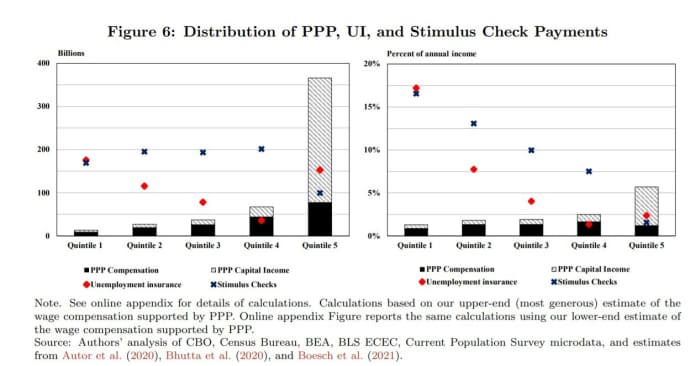
Set yet another way, amongst 23% to 34% of PPP dollars went specifically to personnel who normally would have missing jobs, the examine identified. The method also was really regressive, with a few-quarters of PPP funds accruing to the best quintile of homes.
The authors reported PPP did assist maintain the lights on at establishments that otherwise would have shut, nevertheless they never know whether or not that was a lasting or temporary effect. PPP financial loans served minimize work losses because of to compact-business closures by about 8 share details five weeks right after financial loans ended up been given, the authors mentioned.
Another finding was that so-referred to as 2nd-draw financial loans in 2021 — that is, organizations going back for additional funding a calendar year later — experienced no impact on work. The authors claimed that was “perhaps for the reason that they have been issued far too late to be suitable, after the financial restoration was well underway. If this interpretation is right, it affirms that Congress was clever to prioritize speed more than precision in dispatching the first two tranches of PPP loans.”
‘The United States selected to administer unexpected emergency assist employing a fireplace hose relatively than a hearth extinguisher.’
Other pandemic courses experienced significantly less regressive distributions. Stimulus checks were shut to uniform in greenback terms across the 4 lessen money quintiles, whilst pandemic unemployment coverage rewards went to the two the upper and lessen tails of the domestic-money distribution. (The best quintile benefited from the additional unemployment rewards because self-used business enterprise entrepreneurs had been permitted to acquire.)
The creator explained the main occupation-retention objective of PPP could be improved achieved via increasing “work sharing,” or acquiring businesses minimize work hours somewhat than perform layoffs. There are 26 U.S. states with operate-sharing applications, while they’re not well-subscribed, and the authors say these applications need to be simplified and automated.
Other larger-revenue international locations responded with a combination of task-retention incentives, including function sharing and wage subsidies. “A essential lesson from these cross-countrywide comparisons is that focused organization assistance devices had been feasible and fast scalable in other superior-money countries for the reason that administrative programs for checking employee hours and topping up paychecks were being previously in area, prior to the pandemic. Lacking these types of methods, the United States selected to administer unexpected emergency assist employing a fire hose relatively than a hearth extinguisher, with the predictable consequence that practically the total small-enterprise sector was doused with income,” the authors stated.
In the U.S., the unemployment fee has dropped to 3.9%, from a pandemic peak of 14.9%. The employment-to-population ratio has improved to 59.5% from a pandemic small of 51.3%, but it’s nevertheless down below the February 2020 amount of 61.2%.